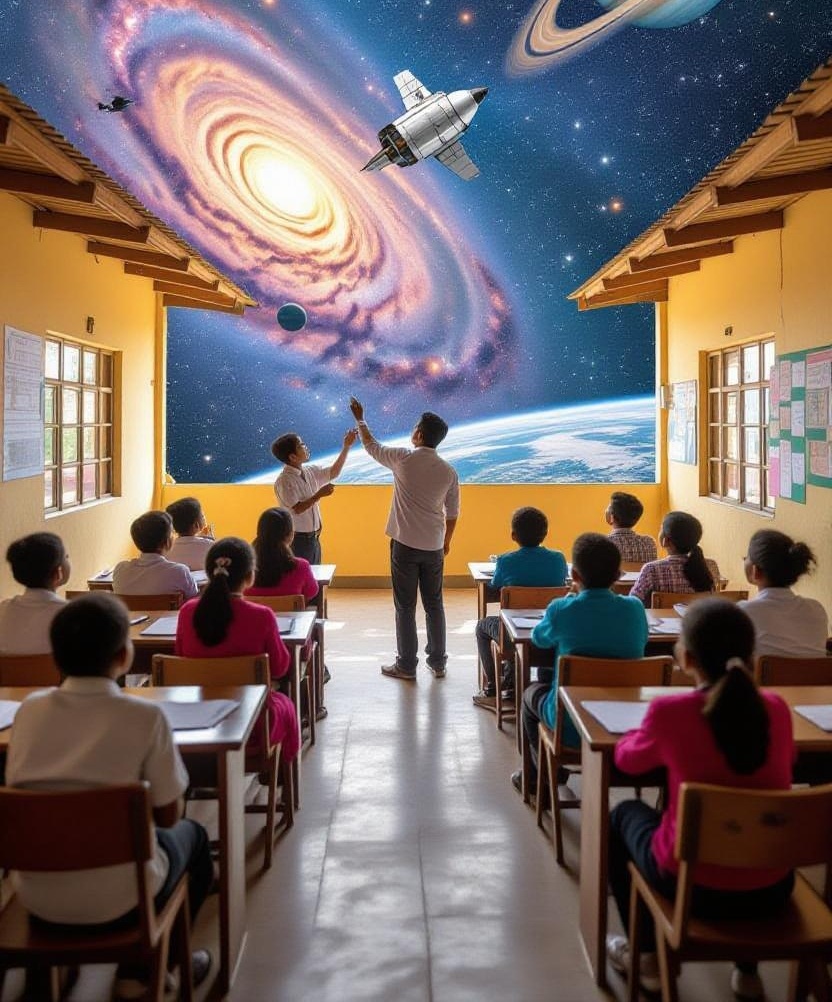
Kokrajhar: Children have always been dreamers. When they look at the night sky, their minds are filled with wonder—sparkling stars become diamonds, the moon becomes the Chanda Mama, a guardian. For them, the space is not unreachable; it is a playground of endless possibilities where imagination and science meet.
The curiosity of children often begins with simple questions: Why does the moon change its shape? Why do stars twinkle? Can we live on Mars? And, the questions are endless.
These questions reflect the natural instinct of young minds to explore the unknown. For them, rockets can be built from cardboard, and astronauts can ride bicycles to the moon.
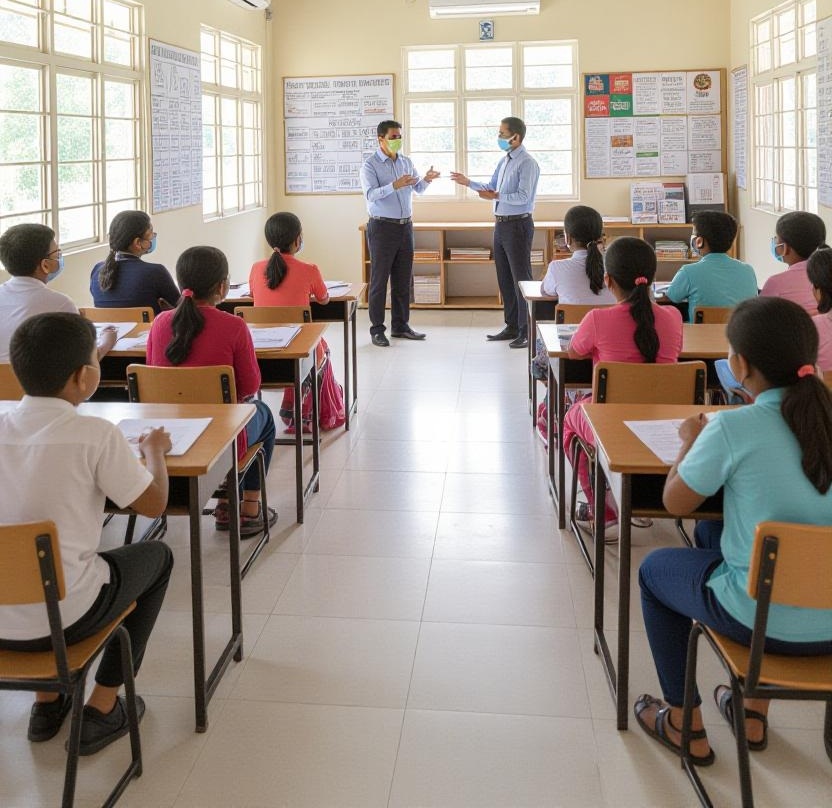
Riding on the infatuation of the ignited young minds, the Bodoland Territorial Region (BTR) has moved swiftly to make the space science a classroom reality, expanding a network of “School Space Labs” to 15 government schools across Bodoland.
The initiative, a dream project of Pramod Boro, Chief of the Bodoland Territorial Region (BTR), framed locally as the Bodoland Space Education Programme, pairs modern laboratory kits and telescopes with mentorship from ISRO-recognised “Space Tutor” agencies, aiming to turn curiosity into practical STEM learning for thousands of students.
As the National Space Day 2025 was celebrated on August 23, with the theme Aryabhatta to Gaganyaan: Ancient Wisdom to Infinite Possibilities, the BTR’s initiative has tried to honour the traditional Astronomy and showcase the modern space achievements.
Because of the positive response, the Bodoland Space Education Programme saw rapid scale-up since its first government-school space lab opened in mid-2024.
The 15-lab milestone was achieved during the National Space Day commemorations this month.
The Bodoland Space Education Programme roots trace to a Memorandum of Understanding signed between the BTR government and New Delhi-based Vyomika Space Academy, initially to set up labs in 10 higher secondary schools.
That agreement positioned Vyomika—an ISRO Space Tutor partner—to supply curriculum, training, and hardware such as model launch vehicles, telescopes, CanSat kits, and mission-aligned teaching materials.
The Bodoland Space Education Programme saw huge response across Bodoland as Space Science nurtures creativity and is filled with mysteries yet to be solved.
“The thought of black holes swallowing light, galaxies stretching endlessly, or humans living on other planets sparks both wonder and determination,” Prabhat Basumatary, father of 16 year-old Chittaranjan, said.
Chittaranjan draws his inspiration from American astronomer Carl Edward Sagan, and is determined to work for organsations like ISRO, NASA, or even the SpaceX.
Most of Chittaranjan’s friends imagine themselves as astronauts, scientists, or even inventors of machines that can travel faster than light. Their drawings often show colorful spaceships, friendly aliens, or magical planets.
A timeline of quick wins
The first milestone came on July 19, 2024, when BTR inaugurated the Chino Basumatary Memorial Space Laboratory at Sidli-Kashikotra Higher Secondary School in Chirang, widely cited as the first such lab in any government school in the Northeast.
The event brought together the BTR leadership, senior education officials and space experts, signaling that this was not a one-off facility but the start of a network.
“Students of our school are always excited to attend the classes at the Space Lab, and I am optimistic that our school will be able to produce space scientists of the future,” Manju Boro, Principal of Sidli-Kashikotra Higher Secondary School, said.
Subsequently, the BTR government attached memorial names to the other labs to honour educators and community figures and to anchor a sense of ownership in each town.
Named labs, local pride
- Chino Basumatary Memorial Space Lab, Sidli-Kashikotra HS School (Chirang)
- Mathias Tudu Memorial Space Lab, Grahampur HS School (Kokrajhar)
- Sumilal Narzary Memorial Space Lab, Tipkai HS School (Kokrajhar)
- Brajendra Kumar Brahma Space Lab, Kokrajhar HS School (Kokrajhar)
- Marjit Brahma memorial Space Lab, Kachugaon High School (Kokrajhar)
- Jogen Basumatary Memorial Space Lab, Basugaon HS School (Chirang)
- Sanjarang Lakeswar Brahma Memorial Space Lab, Bijni Bandhab HS School (Chirang)
- Mohendra Narzary Memorial Space Lab, Amguri HS School (Chirang)
- Bijendra Wary Memorial Space Lab, Runikata HS School (Chirang)
- Nilesh M Desai memorial Space Lab, Barama Girls High School (Baksa)
- Dharanidhar Wary Memorial Space Lab, Salbari High School (Baksa)
- Haladhar Ujir Memorial Space Lab, Talumpur HS School (Tamulpur)
- Doleswar Boro memorial Space Lab, Udalguri HS School (Udalguri)
- Amrit Chandra Kachari Memorial Space Lab, Khoirabari HS School (Udalguri)
- Baliram Boro Memorial Space Lab, Harisinga HS School (Udalguri)
Such naming choices, local leaders argue, weave the labs into the region’s cultural fabric and ensure they are seen as community assets rather than elite, locked rooms.
What students get inside a Space Lab
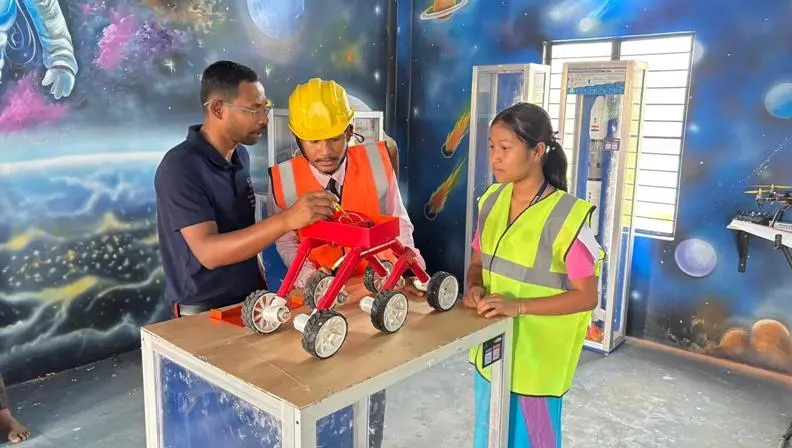
The Space Labs are designed for tactile learning. Instead of limiting astronomy and rocketry to textbook diagrams, the rooms are fitted with optical telescopes for planetary observation, scaled models of PSLV/GSLV launchers, CanSat-style payload kits for simulated launches, and microcontroller-based experiments that cover sensors, propulsion basics, and telemetry.
ISRO-aligned content allows teachers to connect India’s recent missions to classroom exercises. The students can plan a mock lunar observation campaign after hearing about Chandrayaan instrumentation, or replicate payload integration steps using small kits.
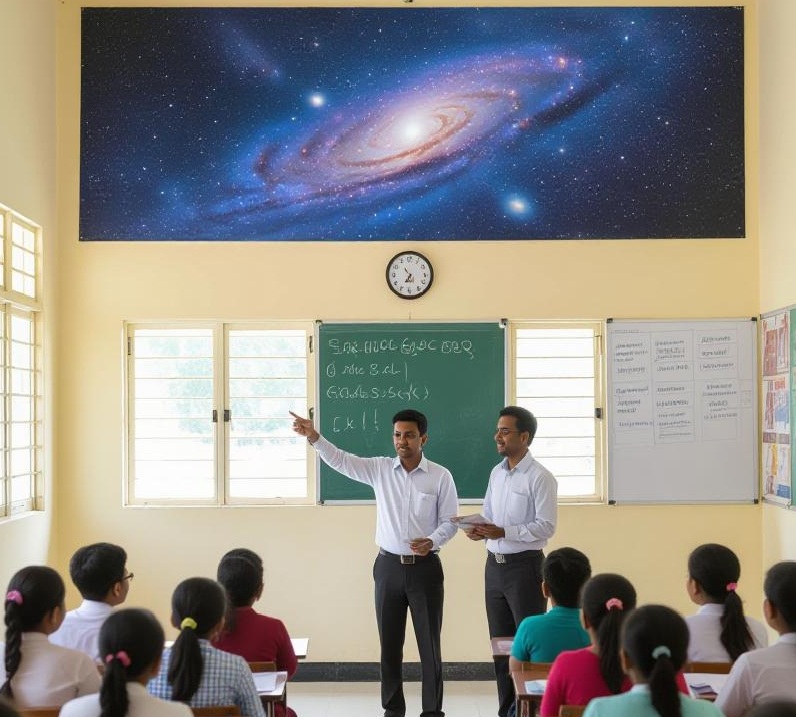
The Bodoland Space Education Programme also invests in teacher capacity. As the Space Labs arrive, partner trainers conduct boot-camps for science teachers, demonstrating how to run rocket-building workshops safely, align experiments to the state syllabus, and use observation logs to evaluate learning outcomes.
The pedagogic goal is to convert a once-a-year “science fair” mindset into weekly lab work, club meets, and field observations under the night sky.
Why now?
Space education is one strand in BTR’s larger effort to raise science learning outcomes and reduce disparities that have historically affected the region.
Academic analyses have documented horizontal inequalities in schooling across BTR; the government’s response has paired infrastructure upgrades with programmatic interventions, school adoption schemes, university expansion, smart labs and now Space Labs.
In early August, Bodoland University also announced new infrastructure in Udalguri under the “Smart Bodoland” vision, reinforcing the same arc, access plus quality.
From classroom to launchpad
The BTR model could seed a pipeline from school clubs to collegiate innovation hubs and internships at national facilities.
There is no doubt that the BTR’s Bodoland Space Education Programme would put the region’s learners on a truly national stage. Even without a satellite on the immediate horizon, the labs’ current kit—CanSats, avionics basics, and night-sky observation, already deliver the core of mission-style learning.
Early impact and participation
Vyomika Space Academy has stated that over 3,000 tribal students from BTR have already engaged with its space-education programming—an indicator that the labs are not lying idle.
District-level events, including National Space Day activities inside the labs, show students building water-propelled rockets, crafting payload enclosures, and explaining orbital concepts in Assamese, Bodo and English to visiting officials and parents.
These public demonstrations are central to the programme’s community ethos: they turn school science into a spectacle of possibility for younger children and a point of pride for towns that host a lab.
A regional first—and a signal
When BTR leaders say the region now celebrates 15 School Space Labs, the first network of its kind in government schools anywhere in the Northeast, they are staking a claim that blends symbolism with strategy.
For a region long typecast by its challenges, the image of teenagers in Bijni or Sidli aligning telescopes and debugging microcontrollers is more than a feel-good photo.
It is a practical bet that the route to opportunity in 2030s India will run through labs like these—and that Bodoland’s students should be at the front of that queue.