BTR । Even as India is moving rapidly towards digital governance, the Sixth Schedule tribal councils in Northeast India continue to face significant hurdles in digitizing the land records.
Despite ambitious goals under the Digital India Mission and growing demand for transparency in land ownership, the complexities of customary landholding patterns, infrastructural gaps, and limited digital literacy have made the task a formidable challenge.

There are 10 tribal councils constituted under the Sixth Schedule of the Constitution in Northeast India.
There are three Sixth Schedule Councils in Assam – the Bodoland Territorial Council, Karbi Anglong Autonomous Council, and the Dima Hasao Autonomous District Council.
In Meghalaya, there are three Sixth Schedule Councils – the Garo Hills Autonomous District Council, the Jaintia Hills Autonomous District Council, and the Khasi Hills Autonomous District Council.
While there is only one tribal autonomous council in Tripura, Mizoram has three councils – the Chakma, Mara, and Lai Autonomous District Councils, and all of them are under the Sixth Schedule of the Constitution.

The Sixth Schedule of the Constitution provides special provisions for the administration of tribal areas. These Autonomous Councils are empowered to manage land, forest, and local governance in their jurisdictions.
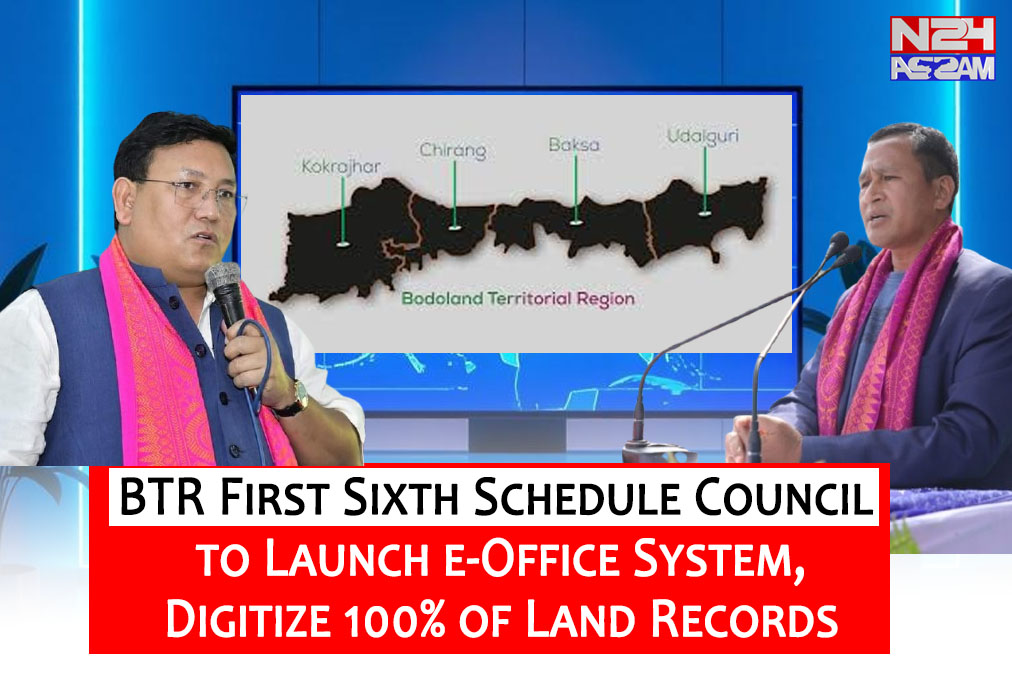
In a historic achievement, the Bodoland Territorial Region (BTR) government has become the first Sixth Schedule autonomous council in Northeast India to successfully launch an e-Office system and achieve 100% digitization of land records.
More than 15 lakh land documents in Bodoland have been successfully digitized, and the documents include texts and maps.

The digital achievement of Bodoland has earned special appreciation of Government of India, and the other Sixth Schedule councils in Northeast India have been asked to take lessons from Bodoland.
By being the first Sixth Schedule Council in the entire Northeast to achieve full digitization of land records, BTR has set a benchmark for other councils to follow.
The move marks a major step towards transparent governance, digital transformation, and efficient service delivery in one of the most strategically significant tribal regions of Assam.
The initiative, spearheaded under the leadership of Pramod Boro, the incumbent Chief Executive Member, brings the governance model of the region at par with many progressive states of the country, aligning it with the national vision of Digital India and Minimum Government, Maximum Governance.
A Digital Breakthrough for Sixth Schedule Areas
While these councils have often struggled with limited resources, infrastructural gaps, and administrative bottlenecks, the BTR government’s adoption of technology-driven governance is being seen as a turning point.
The e-Office system, a digital platform for office file movement and decision-making, will now replace age-old manual file systems in Bodoland.
The system enables electronic handling of files, real-time tracking of decisions, online approvals, and a paperless administrative culture.
Simultaneously, the completion of 100% digitization of land records ensures that every land parcel within BTR’s jurisdiction is now mapped, updated, and stored in secure digital form.
Citizens within the territory of BTR will now be able to access land records online, apply for mutations, verify ownership, and receive digitally signed documents without the need for middlemen or repeated visits to government offices.
The Path to Digitization
According to Dhiraj Saud, Secretary of BTC, the Bodoland government began the process of digitizing land records in early 2023, and has successfully completed it.
The task involved ground-level surveys across all subdivisions of Kokrajhar, Chirang, Baksa, Tamulpur, and Udalguri districts.
Old land records, some dating back several decades, were digitized and cross-verified with revenue records and maps. Geographic Information System (GIS) mapping was integrated to ensure accuracy in land boundaries.The new digital platform now allows farmers, landowners, and common citizens to check their land status through kiosks, mobile applications, and web portals.
An official from the Land Revenue Department of BTR said, “This is a revolution for the region. Land disputes have often been the cause of social tension in our area. By digitizing records, we are ensuring transparency and minimizing chances of corruption, forgery, and conflict.”A farmer from Baksa district, who recently accessed his digital patta, said, “Earlier, we had to wait for months to get land documents. Now it is available in minutes. This has given us confidence that the government is truly working for the people.”
The initiative is also being seen as a major administrative reform that strengthens the credibility of the BTC government.
Under Mission Basumoti 1.0, which provides 14 services, two lakh 34 thousand application were received, and more than two lakh eleven thousand applications have been disposed.
The Basumoti 2.0 was launched few months ago by Laxman Prasad Acharya, Governor of Assam, and so far, 23,647 applications have been received. Of the 23,647 applications, the BTC government could dispose 300 applications. In fact, disposal of the applications are taking little more time because the applicants also include about 9,000 small tea garden owners. And, this is for the first time, the small tea growers got their land settlement done, for which, they have also started getting the benefits from the Tea Board of India.
The e-Office system and land record digitization are not just administrative reforms but are instruments of justice, equality, and empowerment for our people, one of the Land Recods Department officials, said.The official said BTR’s e-Office system and land record digitization initiative has become a case study for other autonomous councils like those in Karbi Anglong, Tripura, and Meghalaya, paving the way for a new era of digital governance in tribal regions.While the achievement is significant, officials admit that challenges remain. Internet penetration in remote areas of BTR is still limited, and many citizens, particularly in villages, lack digital literacy.
To address this, the BTR administration has started training sessions in villages to teach citizens how to access land records online.Digital kiosks are also being set up at block and panchayat levels to provide assistance.The BTR administration also ensured the safety of sensitive land data from hacking or misuse.Dhiraj Saud said, “Digitization is only the first step. The real challenge lies in making these services accessible to the last mile and ensuring people trust and adopt the system.”Officials from the Ministry of Electronics and IT have lauded the council’s proactive steps and expressed willingness to provide further support for scaling up digital services in BTR.Political observers believe that this digital milestone could also boost the popularity of the ruling United People’s Party Liberal (UPPL) ahead of the 2025 Bodoland Territorial Council elections, as it demonstrates a visible commitment to reform and good governance.